Sunday, 16 September 2012

Ice Kacang Cooler Box

Ice Kacang Cooler Box

Task:

To create an ice cooler box out of materials best able to prevent heat transfer in order to keep ice kacang from melting.


3 ways through which heat transfers:


  • Conduction
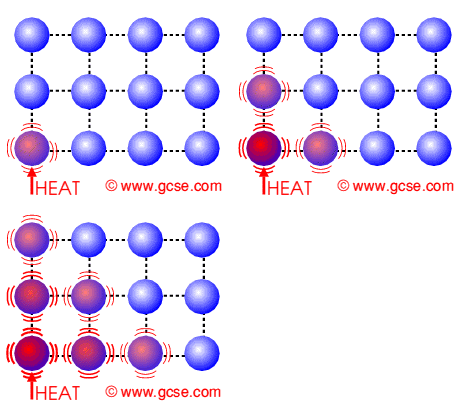
The transfer of heat from particle to particle by diffusion and collisions of the particles within a body due to a temperature gradient


  • Convection


The transfer of heat from one place to another by the movement of fluids e.g. air


  • Radiation

A process in which energetic particles or energetic waves travel through vacuum


Materials used:

-Aluminium foil


-Plastic container


Aluminium foil:

-Wrapped around the outside of the plastic container to prevent heat transfer from outside of box to the inside


-The surfaces of aluminium foil are shiny and reflective, therefore aluminium is a poor emitter of radiation and does not absorb heat by radiation easily, instead reflecting the infra red radiation


-Thus, gaining of thermal heat energy from the surroundings of the box through radiation is greatly reduced


Plastic container:

-Forms main body of the cooler box and prevents heat transfer from surroundings to the object within


-Plastic is a poor conductor of heat, an insulator, as it is not a metal with free flowing electrons that are the main reason why metals are the best conductors of heat


-These delocalised electrons when heated are able to move between the ions down the temperature gradient, colliding and transferring the thermal heat energy to neighbouring ions efficiently


-On the other hand, in plastic, heat is conducted slowly from atom to atom, resulting in a longer time needed for heat from the outside of the box to travel to the inside of the box

Thursday, 13 September 2012

METHOD

Aim: To prevent the ice from melting
Materials: Aluminium foil, Styrofoam box

In order to melt, a block of ice needs to absorb a considerable amount of energy. The ice and ice water will stay at freezing temperature until the ice has nearly completely melted.

Convection and Conduction

  • An ice cooler mainly has to prevent two kinds of warming: convection and conduction. Convection occurs when currents of a fluid such as air move heat from a hotter object to a cooler one. Conduction occurs when heat moves directly from a warmer object to an adjacent colder one. Coolers are designed to minimize both kinds of heating.

Preventing Conduction

  • Warmer molecules are moving faster than cooler ones. When a warm molecule bumps into a cold one, some of that motion is transferred, making the cold molecule move a little faster (i.e., get a little warmer.) Air is an extremely poor conductor because the molecules are spread out. Styrofoam has lots of tiny air bubbles inside of it. The heat can not flow efficiently through the material from outside to inside, since all of the air bubbles slow it down. Air does leak through, but it does so very slowly, keeping things cool inside.

Preventing Convection

  • When a cooler is opened, convection currents immediately take their toll. Warm air blows in, melting the ice inside and warming up the cooler. As long as styrofoam coolers are kept closed most of the time, convection does little to warm them up. Air currents can warm the surface of the cooler, but this warmth takes a long time to get inside because of the insulating properties of the styrofoam.
  • ALUMINIUM:
  • Although ice cannot be prevented from melting , there are ways to keep it frozen for just a little longer. Thermally insulated cooler boxes are pretty good for this. These containers prevent the transfer of heat from the inside of the container to the exterior and vice-versa. Ice buckets and Styrofoam boxes take advantage of this principle to keep ice from melting. Common thermal insulators include nylon lined fabrics, styrofoam and hard plastics.

    Keeping ice in light-colored containers or reflective containers might also help keep it frozen. Theoretically, lighter colors and reflective surfaces absorb less radiation from the sun. This should mean that a smaller quantity of heat would be and therefore the ice should melt more gradually. As an alternative to reflective containers, perhaps the ice can be covered with aluminum foil to obtain similar results.
  • THERMAL HEAT TRANSFER

    Conduction
    The transfer of heat energy by microscopic diffusion and collisions of particles or quasi-particles within a body due to a temperature gradient.

    Convection
    the transfer of heat from one place to another by the movement of fluids.

    Radiation
    a process in which energetic particles or energetic waves travel through vacuum